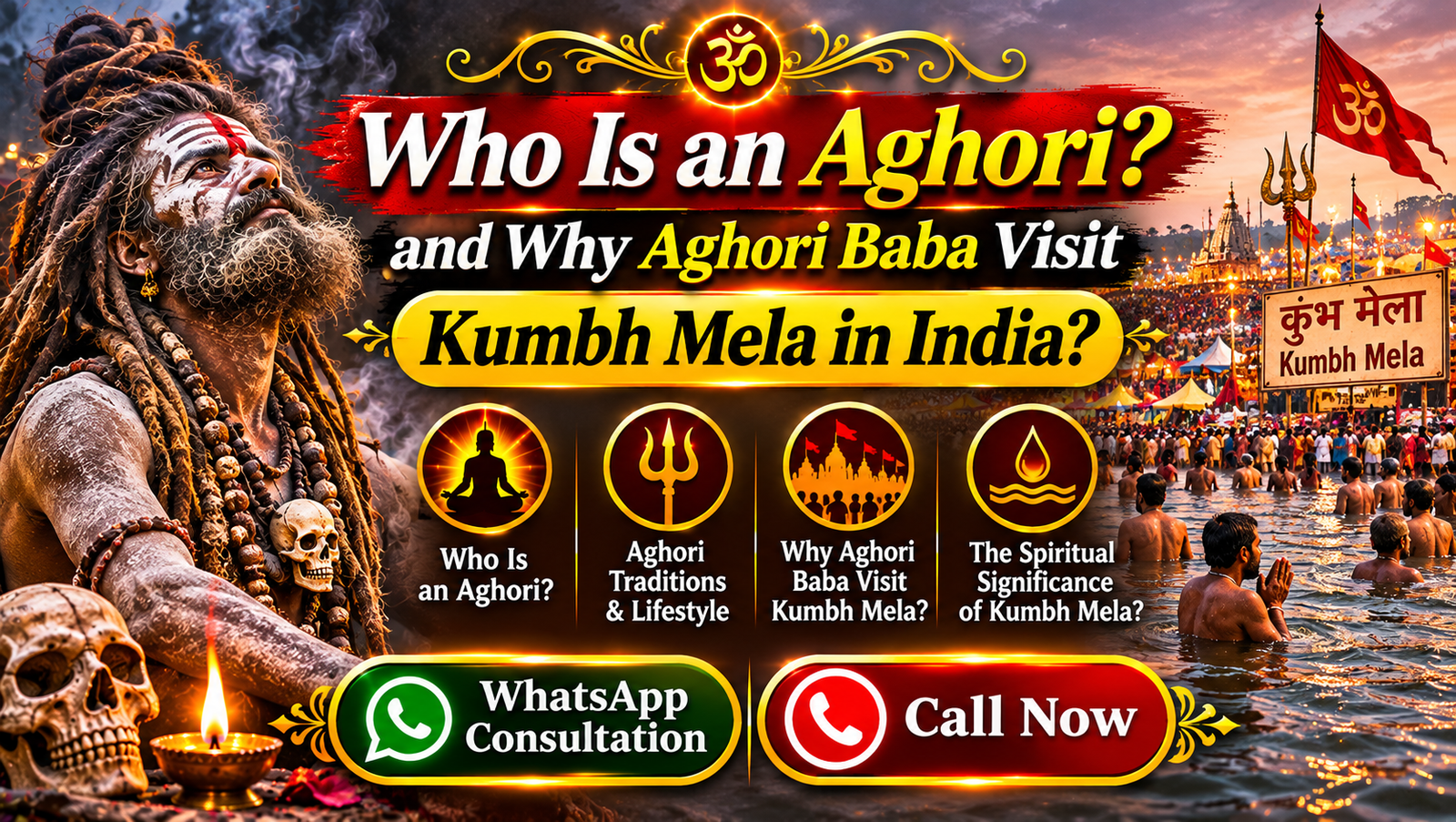
India is home to many ancient spiritual traditions, but few attract as much curiosity as the Aghori tradition. Its distinctive lifestyle, spiritual beliefs, association with cremation grounds and unusual religious practices have made people across the world curious about who Aghoris really are.
One question that attracts particular attention is: Who Is an Aghori, and why does an Aghori Baba visit Kumbh Mela in India?
Some people associate Aghoris with mystery, ash-covered bodies, human skulls and secret spiritual practices. Others want to understand their connection with Lord Shiva, their philosophy of life and death, and their place in India’s wider spiritual culture.
Kumbh Mela adds another dimension to this curiosity. It brings together different groups of Hindu ascetics, saints, spiritual teachers and devotees. For people interested in Aghori traditions, the gathering offers an opportunity to learn about India’s diverse ascetic communities and their religious practices.
In this article, we explore Who Is an Aghori, what makes an Aghori Baba different from other spiritual practitioners, why an Aghori may participate in Kumbh Mela, and what people should understand before searching for the Best Aghori Baba in India.
Who Is an Aghori?
An Aghori is a practitioner associated with the Aghor tradition, a distinctive spiritual path within the broader Shaiva traditions of Hinduism. Aghoris traditionally regard Lord Shiva as their supreme spiritual ideal and follow a philosophy centred on overcoming fear, attachment, discrimination and the illusion of separation.
The word Aghor is commonly understood through Sanskrit as meaning that which is not terrible, frightening or difficult. In the spiritual understanding of the tradition, Aghor represents a state beyond fear and ordinary distinctions between pure and impure.
This idea is central to understanding Who Is an Aghori. The Aghor philosophy challenges the way people normally judge the world. Instead of treating certain places, objects or aspects of existence as inherently unacceptable, Aghor teachings encourage practitioners to develop spiritual awareness and move beyond attachment and aversion.
Aghoris are particularly associated with cremation grounds, where they contemplate mortality and the temporary nature of the human body. However, not every Aghori follows exactly the same lifestyle, and not every person who appears unusual or wears ash is an Aghori.
The Aghor tradition is a religious and spiritual path, not simply a collection of mysterious rituals.
Who Is an Aghori Baba?
An Aghori Baba is a spiritual practitioner or teacher associated with the Aghor tradition. The word Baba is commonly used in India as a respectful form of address for a religious teacher, ascetic or spiritual elder.
An Aghori Baba may dedicate his life to meditation, spiritual discipline, worship of Lord Shiva, traditional practices and the teachings of his lineage.
Some Aghori practitioners live in secluded places, including ashrams or areas associated with cremation grounds. Others maintain contact with society and guide people who visit them for spiritual discussions or religious instruction.
An experienced Aghori Baba may spend years following a disciplined spiritual path. Traditional practices can involve:
- Meditation and spiritual contemplation.
- Worship and devotion to Lord Shiva.
- Mantra recitation and traditional forms of sadhana.
- Contemplation of death and the temporary nature of life.
- Learning from a spiritual teacher or guru.
- Practising detachment from material possessions and social status.
The lifestyle of an Aghori Baba should not be judged only by external appearance. The philosophy, discipline, teachings and conduct of the individual are equally important.
Why Does an Aghori Baba Visit Kumbh Mela in India?
Kumbh Mela is one of the largest religious gatherings in the world. It brings together millions of Hindu pilgrims, devotees, saints, ascetics and spiritual communities at sacred locations associated with the festival.
For many ascetics, Kumbh Mela is an important occasion for religious participation, spiritual interaction and community gathering.
But why are people particularly interested in seeing an Aghori Baba in India during Kumbh Mela?
There are several reasons.
1. A Gathering of Different Ascetic Traditions
Kumbh Mela brings together spiritual communities from different Hindu traditions. Shaiva ascetics, Vaishnava groups, Naga sadhus, religious teachers and other renunciant communities participate in the gathering.
The festival provides an opportunity for practitioners to meet members of their wider religious communities, maintain traditional relationships and participate in religious activities.
An Aghori practitioner may also be present, depending on their community, lineage and individual religious commitments.
2. Religious Significance of Sacred Bathing
One of the most important features of Kumbh Mela is the ritual bathing at sacred river locations.
For Hindu devotees, bathing during the festival is associated with spiritual purification, religious merit and devotion. Different ascetic groups participate according to their own traditions and practices.
Some ascetics consider participation in these sacred bathing occasions an important part of their religious observance.
However, Aghoris do not all follow one identical set of Kumbh Mela practices. Participation depends on individual beliefs and spiritual communities.
3. Meeting Spiritual Teachers and Practitioners
Kumbh Mela creates an unusual opportunity to encounter spiritual teachers and ascetics who may otherwise live in distant locations or relatively secluded communities.
People interested in the Aghor tradition may use the gathering to learn about its philosophy, religious history and spiritual teachings.
For practitioners, such gatherings can also provide opportunities to meet other members of their tradition and exchange knowledge.
4. Maintaining Religious Traditions
India’s ascetic traditions have long included gatherings where spiritual teachers, disciples and religious communities come together.
Kumbh Mela provides a public setting for these communities to maintain religious connections, participate in ceremonies and continue established traditions.
For an Aghori practitioner, attending such a gathering may be part of religious and community life. It should not be assumed that every Aghori must attend every Kumbh Mela.
Do Aghoris Visit Kumbh Mela Every Year?
No. Kumbh Mela is not an annual festival.
The major Kumbh Mela gatherings take place at four traditional pilgrimage locations:
- Prayagraj, Uttar Pradesh
- Haridwar, Uttarakhand
- Ujjain, Madhya Pradesh
- Nashik-Trimbakeshwar, Maharashtra
The traditional Kumbh cycle is approximately twelve years at each location, although the broader calendar includes other gatherings, such as Ardh Kumbh at Prayagraj and Haridwar.
This is an important distinction because people sometimes assume that Aghoris visit Kumbh Mela every year. In reality, the festival follows a religious calendar, and individual ascetics decide whether to participate.
Not all Aghoris attend, and those who do may have different reasons for being present.
Are Aghoris the Same as Naga Sadhus?
No. Aghoris and Naga Sadhus are not the same, although both are associated with Hindu ascetic traditions and may attract attention during Kumbh Mela.
Naga Sadhus are generally associated with particular Shaiva monastic orders, especially the Dashanami tradition. They are known for renunciation, religious discipline and participation in major religious gatherings.
Aghoris belong to the Aghor tradition, which is particularly associated with Lord Shiva, non-dual spiritual ideas and the practice of overcoming conventional distinctions between purity and impurity.
Here are some important differences:
| Aghoris | Naga Sadhus |
|---|---|
| Associated with the Aghor tradition | Associated with particular Hindu monastic orders |
| Strongly connected with Aghor philosophy and Shaiva spirituality | Strongly connected with renunciation and monastic discipline |
| Often associated with cremation-ground contemplation | Often associated with akharas and religious gatherings |
| May follow distinctive Aghor spiritual practices | Follow the disciplines of their respective monastic orders |
| Some participate in Kumbh Mela | Major participants in Kumbh Mela |
Both traditions have their own histories, teachers, practices and spiritual identities. They should not be treated as interchangeable.
Why Is an Aghori Associated with Cremation Grounds?
One of the most widely recognised aspects of Aghori tradition is its association with cremation grounds.
For most people, cremation grounds are places connected with sadness, fear and the end of life. In Aghor philosophy, however, such places can become locations for spiritual contemplation.
The human body is temporary, and death is an unavoidable part of existence. By contemplating mortality, practitioners seek to reduce attachment, fear and the illusion that the physical body is permanent.
This practice is connected with the broader Aghor understanding that spiritual awareness should not depend on ordinary social distinctions.
However, cremation-ground practices are not necessarily followed by every person associated with the Aghor tradition. The lifestyle and discipline of individual practitioners can differ considerably.
Do Aghoris Really Eat Human Flesh?
This is one of the most frequently asked questions about Aghoris.
Some historical and ethnographic accounts describe particular Aghori practices involving human remains, including ritual contexts in which cremation-ground remains are used. These accounts have contributed to the public image of Aghoris as mysterious or frightening practitioners.
However, it would be inaccurate to claim that all Aghoris eat human flesh or that this is a normal daily practice of the entire tradition.
The Aghor philosophy is broader than sensational stories about unusual rituals. Its central spiritual ideas concern non-duality, overcoming fear, detachment and seeing beyond conventional distinctions.
When discussing this subject, it is important to distinguish documented accounts of particular practices from exaggerated stories and assumptions about every Aghori.
What Is the Connection Between Aghoris and Lord Shiva?
Lord Shiva holds a central place in Aghor spirituality.
In Hindu religious traditions, Shiva is associated with asceticism, meditation, transformation and the cycle of creation and destruction. His association with cremation grounds and his identity as the great ascetic make him particularly significant within Aghor beliefs.
An Aghori practitioner often understands Shiva as a symbol of spiritual reality that exists beyond ordinary categories and limitations.
The Aghor approach encourages practitioners to overcome fear and attachment and develop a deeper understanding of existence.
This connection with Lord Shiva is one of the most important elements of the Aghor tradition and helps explain why it is considered a distinctive path within Shaiva spirituality.
What Makes an Aghori Baba Different from Other Spiritual Gurus?
An Aghori Baba is associated with a particular spiritual tradition, whereas the word guru can refer to a teacher from many different religious or philosophical backgrounds.
An Aghori Baba may teach through the philosophy and practices of Aghor. Another spiritual guru may focus on meditation, Vedanta, yoga, devotion or a different religious lineage.
Some characteristics traditionally associated with Aghor teachers include:
- Emphasis on overcoming fear and attachment.
- Spiritual contemplation of life and death.
- Devotion to Lord Shiva.
- Guidance within a particular spiritual lineage.
- A philosophy that challenges conventional ideas of purity and impurity.
Not every spiritual teacher who wears saffron clothing, keeps long hair or uses religious symbols is an Aghori Baba. A person’s actual tradition and teachings matter more than appearance.
Who Is the Best Aghori Baba in India?
People frequently search online for the Best Aghori Baba in India, a famous Aghori Baba or a genuine Aghori Baba who can explain the Aghor tradition.
But what does the phrase Best Aghori Baba actually mean?
There is no universally recognised official ranking that establishes one person as the best Aghori Baba in the country. Aghor is a spiritual tradition with different teachers, lineages and communities.
For someone interested in learning about an Aghori Baba in India, it is more useful to understand the person’s background, teachings, spiritual lineage and conduct than to rely on popularity or dramatic claims.
A genuine spiritual teacher should be approached with respect and reasonable questions. People should be cautious of anyone who promises guaranteed supernatural results, demands large payments through fear or pressures visitors into secret rituals.
How to Identify a Genuine Aghori Baba
If you are searching for the Best Aghori Baba or a respected Aghor spiritual teacher, consider the following points:
1. Understand the Spiritual Background
Learn about the person’s connection with the Aghor tradition, spiritual teacher and religious lineage.
2. Pay Attention to Their Teachings
A serious spiritual teacher should be able to explain their philosophy and practices without depending entirely on frightening stories or extraordinary claims.
3. Avoid Guaranteed Promises
Be cautious of anyone claiming guaranteed solutions to every personal, financial, relationship or family problem through secret rituals.
4. Respect Personal Boundaries
Spiritual guidance should never involve pressure, threats, exploitation or demands that make a visitor uncomfortable.
5. Look Beyond Appearance
Ash, unusual clothing, long hair and religious objects do not independently establish that someone is a genuine Aghori practitioner.
Understanding these points can help readers distinguish meaningful spiritual learning from sensational claims.
Why Are People So Curious About Aghori Babas in India?
The Aghor tradition attracts attention because it challenges many ordinary ideas about spirituality, life and death.
People often have questions such as:
- Who Is an Aghori and what does the word Aghor mean?
- Why does an Aghori Baba live near cremation grounds?
- Do Aghoris worship Lord Shiva?
- Why do some Aghoris use human skulls?
- Do Aghoris really eat human flesh?
- What is the connection between Aghoris and Kumbh Mela?
- Are Aghoris and Naga Sadhus the same?
- How can someone learn about the Aghor tradition?
These questions reflect a desire to understand a spiritual path that is less familiar to the general public.
The best way to explore the subject is through its history, philosophy, religious practices and the experiences of people who have studied the tradition, rather than relying only on dramatic images or rumours.
Frequently Asked Questions About Aghori and Kumbh Mela
1. Who Is an Aghori in India?
An Aghori is a practitioner of the Aghor tradition, a Shaiva spiritual path associated with Lord Shiva, non-dual philosophy and overcoming fear, attachment and conventional distinctions between pure and impure.
2. Who Is an Aghori Baba?
An Aghori Baba is a spiritual practitioner or teacher associated with the Aghor tradition. Such a practitioner may follow meditation, worship, mantra recitation and other traditional spiritual disciplines.
3. Why Does an Aghori Baba Visit Kumbh Mela?
An Aghori Baba may visit Kumbh Mela to participate in religious gatherings, sacred bathing occasions, spiritual activities and meetings with other ascetics and teachers. Not every Aghori attends.
4. Do Aghoris Visit Kumbh Mela Every Year?
No. Kumbh Mela follows a traditional religious cycle at four pilgrimage locations. It is not held every year at the same location, and participation by Aghori practitioners varies.
5. Are Aghoris and Naga Sadhus the Same?
No. Aghoris belong to the Aghor tradition, while Naga Sadhus are associated with particular Hindu monastic orders. Both may be present at major religious gatherings, but their identities and practices differ.
6. Do Aghoris Worship Lord Shiva?
Yes. Lord Shiva has a central place in Aghor spirituality. Aghori practitioners often understand Shiva as the supreme spiritual reality beyond ordinary distinctions.
7. Why Does an Aghori Live in Cremation Grounds?
Some Aghori practitioners use cremation grounds as places for meditation and contemplation of mortality. These practices are connected with overcoming fear and attachment, but not every Aghori lives in such places.
8. Do Aghoris Really Eat Human Flesh?
Some accounts describe particular Aghori practices involving human remains, but it is inaccurate to say that all Aghoris eat human flesh. Such claims should be considered in their specific historical and ritual context.
9. Can People Meet an Aghori Baba at Kumbh Mela?
Visitors may encounter different ascetic communities during Kumbh Mela. However, not every Aghori attends, and some practitioners prefer privacy or do not interact with visitors.
10. Who Is the Best Aghori Baba in India?
There is no universally accepted official ranking of Aghori Babas in India. Anyone interested in the tradition should consider a teacher’s background, lineage, teachings and conduct rather than relying on unsupported claims of being the best.
Conclusion: Understanding Aghori Baba and Their Connection to Kumbh Mela
The question Who Is an Aghori opens the door to understanding one of India’s distinctive Shaiva spiritual traditions. Aghoris are not simply mysterious figures associated with cremation grounds or unusual rituals. Their philosophy is rooted in the pursuit of spiritual awareness, the overcoming of fear and attachment, and a different understanding of purity, impurity and existence.
Their connection with Kumbh Mela is part of the wider story of India’s ascetic communities. The festival brings together different religious traditions and gives participating practitioners an opportunity to take part in sacred gatherings, maintain spiritual connections and follow their religious observances.
For anyone searching for an Aghori Baba in India, the Best Aghori Baba in India or the meaning of the Aghor tradition, understanding its philosophy and history is a much better starting point than relying on rumours.
At www.aghoribabaji.com, readers can continue exploring Aghori traditions, spiritual history, religious practices and the cultural significance of Aghori Baba in India.