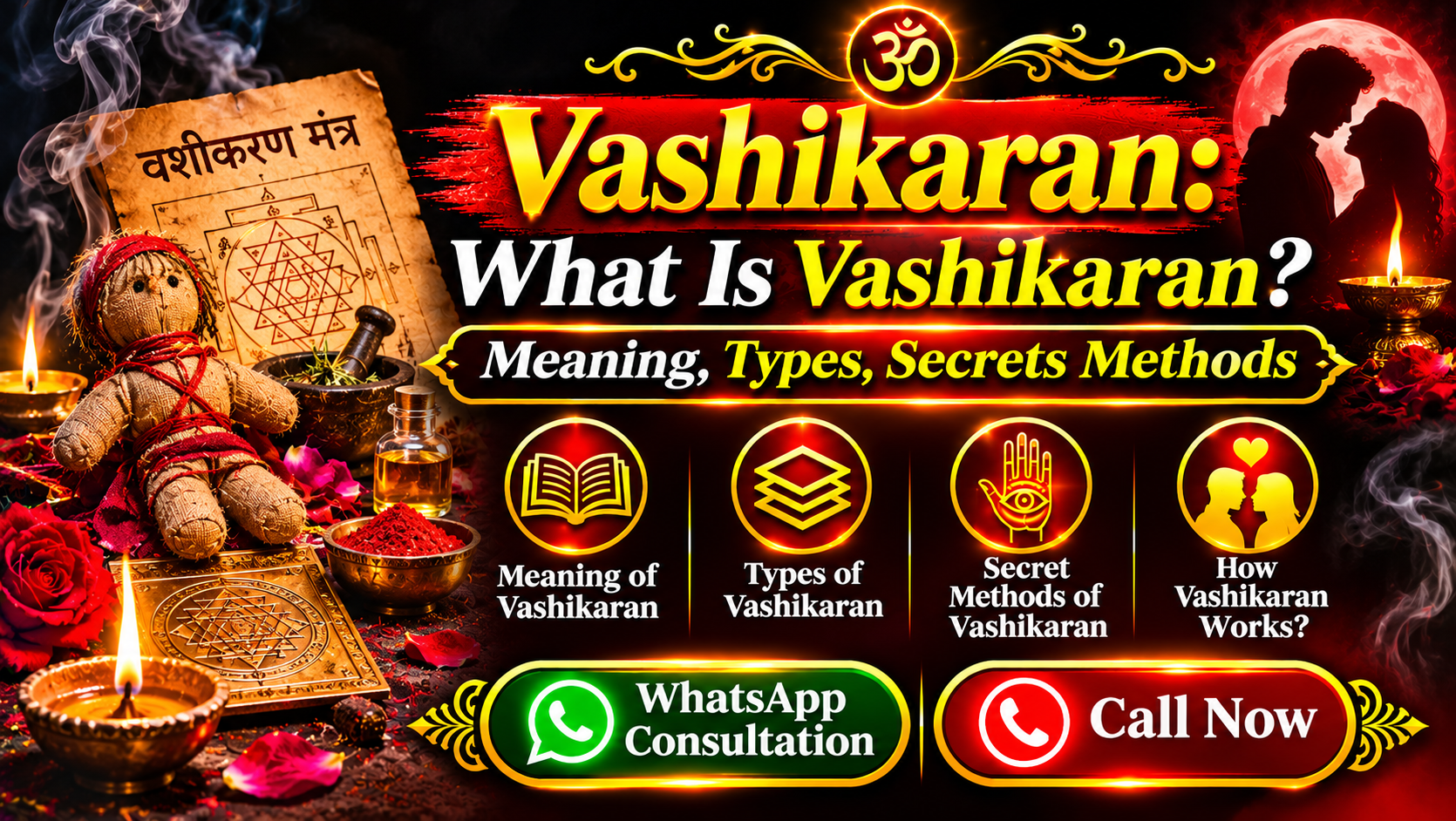
Vashikaran (वशीकरण) is one of the most searched and discussed subjects associated with traditional Indian spiritual practices, Mantra, Tantra and astrology. Some people search for its meaning because they are interested in ancient Indian traditions. Others want to understand Vashikaran Mantra, Love Vashikaran, Pati Vashikaran, Mohini Vashikaran or the belief that a person can be influenced through spiritual practices.
But what does Vashikaran actually mean? Is it an ancient Mantra practice? What is the difference between Vashikaran and Tantra? How is Vashikaran described in traditional literature? Can someone really control another person’s thoughts? And what do people mean when they search for Vashikaran ke Lakshan or Vashikaran Todne ke Upay?
There is much more to this subject than the short explanations commonly found online.
The word Vashikaran has a Sanskrit background and appears in different Indian religious, literary and ritual contexts. Its interpretation can range from attraction and fascination to influence and subjugation. Over time, the word has also become widely associated with love, marriage, relationship concerns and popular spiritual services.
This detailed guide explores Vashikaran meaning in Hindi and English, its traditional background, different types, Mantras, Yantras, Tantrik practices, popular beliefs, common questions and misconceptions.
The purpose is to explain the subject in a way that is informative, culturally grounded and easy to understand.
1. What Is Vashikaran? (वशीकरण क्या है?)
Vashikaran is a Sanskrit-derived term traditionally associated with attraction, influence, fascination or bringing someone under one’s influence.
The word is commonly explained through two parts:
- Vash (वश): To bring under influence, control or sway.
- Karan (करण): The act, process or method of doing something.
Together, Vashikaran is generally understood as the act or practice of influencing or bringing something under one’s influence.
In traditional Indian spiritual and Tantrik contexts, Vashikaran is associated with certain Mantras, rituals and practices. In popular culture, however, the term is most commonly connected with love attraction, relationship concerns and the belief that one person can influence another person’s feelings.
It is important to distinguish traditional religious beliefs from scientifically established facts. There is no reliable scientific evidence that a Vashikaran ritual or Mantra can override another person’s free will or guarantee that someone will fall in love.
2. Vashikaran Meaning in Hindi (वशीकरण का अर्थ)
वशीकरण भारतीय पारंपरिक धार्मिक, आध्यात्मिक और तांत्रिक चर्चाओं से जुड़ा एक शब्द है।
इसका सामान्य अर्थ किसी व्यक्ति या परिस्थिति को अपने प्रभाव में लाने, आकर्षित करने या वश में करने की अवधारणा से जुड़ा है।
वशीकरण शब्द का प्रयोग अलग-अलग संदर्भों में किया जाता है। कहीं इसे आकर्षण और सम्मोहन से जोड़ा जाता है, तो कहीं इसका अर्थ प्रभाव या नियंत्रण से संबंधित होता है।
आज के समय में वशीकरण शब्द का उपयोग विशेष रूप से इन विषयों के लिए किया जाता है:
- प्रेम वशीकरण
- पति वशीकरण
- पत्नी वशीकरण
- मोहिनी वशीकरण
- वशीकरण मंत्र
- नाम वशीकरण
- वशीकरण साधना
- वशीकरण के लक्षण
- वशीकरण तोड़ने के उपाय
हालाँकि, इन सभी शब्दों का अर्थ और पारंपरिक संदर्भ एक जैसा नहीं है। इसलिए वशीकरण को समझते समय इसके मूल अर्थ और आधुनिक उपयोग के बीच अंतर जानना जरूरी है।
3. Vashikaran Kise Kahate Hain? (वशीकरण किसे कहते हैं?)
When people search Vashikaran Kise Kahate Hain, they usually want a direct and simple definition.
परंपरागत रूप से किसी व्यक्ति या परिस्थिति को आकर्षित करने, प्रभावित करने अथवा अपने वश में करने से जुड़ी अवधारणा को वशीकरण कहा जाता है।
In traditional discussions, Vashikaran is associated with particular Mantras, rituals and spiritual practices. In modern conversations, it is frequently connected with love, attraction, marriage and relationships.
There are three important ideas behind the term:
Attraction: Drawing attention or creating fascination.
Influence: Having an effect on someone’s thoughts, behaviour or decisions.
Subjugation: Bringing someone or something under one’s control.
The precise meaning depends on the historical text or tradition being discussed.
This distinction is important because modern advertisements sometimes describe every form of attraction, love-related ritual and spiritual practice as Vashikaran, even when the original meanings may be different.
4. History of Vashikaran: Where Did the Concept Originate?
To understand Vashikaran properly, it is useful to explore its linguistic and historical background rather than relying only on modern advertisements.
The Sanskrit term Vaśīkaraṇa has been recorded in Sanskrit dictionaries and traditional literature. Its meanings include fascinating, attracting, enchanting and subjugating.
The word also appears in different literary and religious contexts. It is therefore not accurate to describe it as belonging exclusively to one modern spiritual organisation or one single Tantrik lineage.
Vashikaran in Sanskrit Literature
Traditional Sanskrit dictionaries provide several meanings of Vaśīkaraṇa. These include attraction, fascination and subjugation.
The term’s meaning can be understood more clearly by looking at how it appears in different types of literature.
For example, discussions associated with Kāmaśāstra use the concept in relation to attraction and the art of winning affection. Some religious and ritual texts use it in the broader context of influence-related practices.
The important point is that the word has a wider literary history than its modern association with love-related services.
Vashikaran and the Atharvaveda
The Atharvaveda contains hymns and ritual material associated with several subjects, including protection, healing, relationships and different human concerns.
Some popular explanations connect Vashikaran-related concepts with Atharvavedic traditions. However, individual hymns should be examined in their original context rather than assuming that every modern Vashikaran Mantra comes directly from the Atharvaveda.
A reference to attraction or influence in an ancient text is not proof that a modern ritual can control another person’s mind.
Vashikaran and the Kamasutra
The Kāmasūtra is an ancient Sanskrit work associated with Kāmaśāstra, the study of love, relationships and human desire.
Its discussions include attraction and the idea of winning someone’s affection. This provides an important literary context for understanding why Vashikaran has historically been connected with attraction.
However, the Kāmasūtra should not be confused with a modern collection of guaranteed Vashikaran spells. It belongs to a much wider literary and cultural tradition.
Vashikaran in Tantrik Literature
Certain Tantrik and religious traditions discuss Vashikarana as an influence-related ritual concept.
Some traditions classify it alongside other ritual actions, while others use different terminology and interpretations.
It is important to understand that Tantra is not a single book or one uniform system. Different Tantrik traditions have different philosophies, deities, rituals and practices.
This is why the historical meaning of Vashikaran should be studied through specific texts and lineages rather than through unsupported claims.
5. Vashikaran Kaise Hota Hai? (वशीकरण कैसे होता है?)
One of the most common searches is Vashikaran Kaise Hota Hai?
Traditional descriptions associate Vashikaran with different forms of spiritual and ritual practice. Depending on the tradition, these may include Mantra Jaap, Puja, Yantra, meditation, worship and Sadhana.
There is no single universal procedure accepted by every tradition.
The following elements are commonly mentioned when discussing Vashikaran.
5.1 Vashikaran Mantra Jaap
Mantra Jaap means the repeated recitation of a sacred Mantra.
Mantras have an important place in Hindu worship, meditation and other Indian spiritual traditions. Some Mantras are associated with particular deities, while others are used for prayer, concentration or specific religious observances.
In Vashikaran-related discussions, Mantras are traditionally associated with attraction or influence.
The meaning, pronunciation and religious background of a Mantra matter. A phrase advertised online as a powerful Vashikaran Mantra should not automatically be assumed to have an authentic scriptural source.
5.2 Puja and Worship
Puja is a traditional form of religious worship.
It may include prayers, flowers, incense, lamps, offerings and the recitation of sacred words.
Different deities and traditions have different forms of worship. A general Puja should not automatically be described as a Vashikaran ritual.
5.3 Yantra
A Yantra is a sacred geometric diagram used in certain Indian religious and spiritual practices.
It may contain geometric shapes, symbols and other traditional elements. Some Yantras are associated with particular deities and forms of worship.
In popular discussions, certain Yantras are connected with Vashikaran. Their meaning should be understood through the specific tradition and religious context in which they are used.
5.4 Sadhana
Sadhana refers to disciplined spiritual practice.
It can include meditation, Mantra recitation, worship and other forms of religious observance.
Some traditional practices are followed under the guidance of a Guru or teacher. The role of discipline and instruction differs according to the lineage.
5.5 Spiritual Intention and Bhava
Bhava refers broadly to one’s inner attitude, feeling or devotional intention.
In many Indian spiritual traditions, intention is considered an important part of worship and Sadhana.
This does not establish that a particular intention can control another person’s mind. It describes the significance that traditional practitioners may give to the inner attitude behind a spiritual practice.
6. What Is Vashikaran Mantra? (वशीकरण मंत्र क्या है?)
A Vashikaran Mantra is a term used for sacred words or phrases associated with traditional attraction and influence-related practices.
A Mantra is not simply an ordinary sentence. In Indian religious traditions, Mantras can have specific linguistic, devotional and ritual meanings.
People commonly search for:
- Vashikaran Mantra
- Vashikaran Mantra in Hindi
- Vashikaran Mantra in English
- Love Vashikaran Mantra
- Pati Vashikaran Mantra
- Patni Vashikaran Mantra
- Mohini Vashikaran Mantra
- Powerful Vashikaran Mantra
- Vashikaran Mantra for Attraction
These expressions are popular search terms, but there is no single universal Vashikaran Mantra used by every tradition.
Is There One Powerful Vashikaran Mantra?
No single Mantra is universally accepted across all Indian spiritual traditions as the one authentic Vashikaran Mantra.
Different religious texts and lineages may describe different Mantras, purposes and methods.
When someone advertises a particular phrase as the only authentic Mantra or guarantees that it will produce a specific result, it is reasonable to ask for the source and traditional context.
What Is the Meaning of Vashikaran Mantra in English?
In English, Vashikaran Mantra can be explained as a sacred chant or ritual formula traditionally associated with attraction, influence or subjugation.
The translation depends on the specific Mantra and the context in which it is used.
Can a Vashikaran Mantra Control Someone?
There is no reliable scientific evidence that chanting a Mantra can force another person to love someone, obey them or surrender their personal decisions.
Mantras may have devotional, meditative and religious significance for practitioners. These meanings should be respected without presenting supernatural control as a scientifically proven result.
7. Different Types of Vashikaran (वशीकरण के प्रकार)
When people search for Vashikaran, they often encounter many related terms. Some are traditional concepts, while others are modern expressions used in popular spiritual discussions.
Here are the major categories readers commonly want to understand.
7.1 Love Vashikaran (लव वशीकरण)
Love Vashikaran is one of the most popular Vashikaran-related search topics.
It is commonly associated with romantic attraction, emotional closeness and relationship concerns.
People searching for Love Vashikaran may be dealing with:
- One-sided love.
- A breakup.
- Emotional distance.
- Misunderstandings between partners.
- Family opposition to a relationship.
- Uncertainty about marriage.
- A desire to rebuild a relationship.
Traditional explanations may associate the subject with Mantras and spiritual practices. However, no ritual can guarantee that another person will develop romantic feelings.
A healthy relationship requires mutual interest, respect and consent.
7.2 Prem Vashikaran (प्रेम वशीकरण)
Prem Vashikaran refers to the idea of love-related attraction or influence.
The word Prem means love. Therefore, the expression is commonly used when discussing romantic feelings and relationships.
In modern searches, Prem Vashikaran and Love Vashikaran often overlap. Different practitioners may explain them in different ways.
7.3 Pati Vashikaran (पति वशीकरण)
Pati Vashikaran is a popular term associated with husband-wife relationships.
People may search for it when they are facing:
- Frequent disagreements.
- Communication problems.
- Emotional distance.
- Lack of trust.
- Family-related tension.
- Difficulties in married life.
The term is used in traditional and modern spiritual discussions, but it should not be interpreted as a guaranteed method of controlling a husband.
Marital relationships require communication, mutual respect and willingness from both partners.
7.4 Patni Vashikaran (पत्नी वशीकरण)
Patni Vashikaran is the corresponding expression associated with wife-related relationship concerns.
It appears in popular searches about marriage, emotional connection and misunderstandings.
As with Pati Vashikaran, the phrase should be understood as a traditional or popular concept rather than proof that a ritual can control a spouse.
7.5 Mohini Vashikaran (मोहिनी वशीकरण)
Mohini Vashikaran is commonly associated with attraction, fascination and charm.
The word Mohini has a place in Indian religious stories and cultural traditions. It is associated with enchantment and captivating appearance.
The modern expression Mohini Vashikaran is used in different ways, so its meaning should be understood in the context of the particular source or tradition.
7.6 Naam Vashikaran (नाम वशीकरण)
Naam Vashikaran is a phrase used in popular discussions about practices involving a person’s name.
Different practitioners may offer different explanations of the concept.
There is no established scientific evidence that using someone’s name in a ritual gives another person control over their thoughts, feelings or decisions.
7.7 Stri Vashikaran (स्त्री वशीकरण)
Stri Vashikaran is a traditional and popular expression associated with the idea of influencing or attracting a woman.
It is often used in online searches about attraction and relationships.
The term should be approached with an understanding of personal autonomy and consent. No person should be treated as an object to be controlled.
7.8 Purush Vashikaran (पुरुष वशीकरण)
Purush Vashikaran is a related expression used in discussions about influencing or attracting a man.
The term is sometimes used in relationship-related spiritual searches.
Its meaning varies according to the practitioner or source using it. It should not be treated as a proven way to change another person’s feelings.
7.9 Jan Vashikaran (जन वशीकरण)
Jan Vashikaran is an expression sometimes used for the idea of influencing people or groups.
It is broader than the relationship-related expressions commonly seen in modern searches.
Its interpretation depends on the particular traditional or popular context.
7.10 Business or Social Influence-Related Vashikaran
Some modern discussions use Vashikaran-related language when talking about business relationships, public influence, communication or gaining attention.
These uses are not necessarily the same as historical ritual practices.
In everyday life, professional relationships are built through trust, communication, reputation and consistent behaviour.
8. Vashikaran and Relationship Problems
One reason Vashikaran is so widely searched is its association with love and marriage.
When a person experiences a breakup or feels emotionally distant from someone, they may search for spiritual explanations or remedies.
Some of the most common related searches are:
- Love Vashikaran for girlfriend.
- Love Vashikaran for boyfriend.
- One-sided love Vashikaran.
- Ex-love Vashikaran.
- Husband-wife relationship Vashikaran.
- Marriage Vashikaran.
- Prem Vashikaran Mantra.
- Pati Patni Vashikaran.
These searches often reflect genuine emotional concerns.
However, it is important to separate the emotional problem from the supernatural claims sometimes associated with it.
One-Sided Love
One-sided love occurs when one person has romantic feelings that are not returned in the same way.
It can be emotionally difficult, particularly when the person hopes that the relationship will change.
Traditional spiritual discussions may connect this situation with Love Vashikaran. In practical terms, however, another person’s feelings cannot be guaranteed through a ritual.
Breakup and Separation
After a breakup, people may search for ways to bring an ex-partner back.
The desire to reconnect is understandable, but a relationship can only be rebuilt when both people are willing.
Communication, accountability, respect and time are more meaningful foundations for reconciliation than promises of guaranteed supernatural results.
Husband-Wife Disagreements
Marriage involves two individuals with different experiences, expectations and personalities.
When misunderstandings become frequent, it may help to identify the actual source of the disagreement and consider respectful communication or professional relationship support.
Vashikaran-related searches should not replace practical steps toward a healthier relationship.
9. What Is Mohini Vashikaran? Understanding Its Cultural Background
Mohini is a familiar figure in Hindu religious stories and traditions.
The name is associated with enchantment, beauty and fascination. One well-known religious narrative describes Vishnu taking the form of Mohini.
Over time, the word Mohini became associated in popular language with charm and attraction.
This cultural background helps explain why the term Mohini Vashikaran is used in modern spiritual discussions.
However, a mythological story and a modern ritual claim are not the same thing. The existence of a religious narrative does not prove that a person can use a ritual to control another person’s feelings.
10. Vashikaran and Tantra: Are They the Same?
No. Vashikaran and Tantra are related in some traditional contexts, but they do not mean the same thing.
Tantra refers to a broad range of Indian religious and spiritual traditions.
Vashikaran is a particular concept associated with influence, attraction or subjugation in certain ritual contexts.
Tantrik traditions may include:
- Mantra.
- Yantra.
- Puja.
- Meditation.
- Sadhana.
- Deity worship.
- Spiritual initiation.
- Ritual observances.
Not every Tantrik practice is connected with Vashikaran. Likewise, not every modern use of the word Vashikaran represents an authentic Tantrik practice.
What Is the Difference Between Vashikaran and Mantra?
Mantra refers to a sacred word, phrase or sound used in religious or spiritual practice.
Vashikaran is a concept associated with influence or attraction.
A Mantra may be used in different spiritual contexts, but that does not make every Mantra a Vashikaran Mantra.
What Is the Difference Between Vashikaran and Yantra?
A Yantra is a sacred geometric diagram used in certain forms of worship and meditation.
Vashikaran refers to an influence-related concept.
Some traditions may associate specific Yantras with Vashikaran, but the two terms have different meanings.
11. What Is the Difference Between Vashikaran and Black Magic?
Vashikaran and Black Magic are often discussed together on the internet, but they are not identical concepts.
Vashikaran is generally associated with attraction, influence or subjugation.
Black Magic is a broad popular expression used for practices believed to cause harm, misfortune or negative supernatural influence.
The distinction depends on the cultural and religious context.
| Subject | General meaning |
|---|---|
| Vashikaran | Attraction, influence or subjugation |
| Black Magic | Popular term for harmful supernatural practices |
| Tantra | Broad religious and spiritual traditions |
| Mantra | Sacred word, phrase or sound |
| Yantra | Sacred geometric diagram |
| Sadhana | Disciplined spiritual practice |
Not every Tantrik practice is Black Magic, and Vashikaran should not automatically be treated as harmful magic.
12. Vashikaran Ke Lakshan (वशीकरण के लक्षण)
The phrase Vashikaran Ke Lakshan is commonly searched by people who believe that they or someone they know may be under the influence of Vashikaran.
Online explanations sometimes list changes in behaviour, emotions, sleep or relationships as signs of Vashikaran.
However, there is no scientifically validated checklist that can identify whether a person is under Vashikaran.
For example, the following experiences are sometimes interpreted as signs in popular discussions:
- Unusual emotional attachment.
- Sudden changes in relationship behaviour.
- Frequent thoughts about another person.
- Difficulty concentrating.
- Changes in sleep.
- Relationship misunderstandings.
- Feeling anxious or confused.
These experiences can have many ordinary explanations, including stress, emotional distress, relationship difficulties, sleep problems and health-related factors.
They should not automatically be attributed to supernatural influence.
If someone experiences persistent anxiety, sleep difficulties or changes in behaviour, it is better to consider appropriate medical or mental health support rather than assuming that Vashikaran is responsible.
Can You Identify Vashikaran Through Behaviour?
No behaviour alone can reliably prove that someone is under Vashikaran.
A person becoming distant, affectionate, upset or confused does not establish that a spiritual ritual has influenced them.
It is important not to accuse someone of performing Vashikaran without credible evidence.
13. Vashikaran Todne Ke Upay (वशीकरण तोड़ने के उपाय)
Another frequently searched expression is Vashikaran Todne Ke Upay.
Some people search for this phrase because they are worried about themselves, their relationship or a family member.
In traditional religious discussions, people may refer to prayer, worship, meditation and other spiritual observances when seeking peace or reassurance.
However, there is no scientifically verified method for detecting and removing supernatural Vashikaran.
A sensible approach is to avoid fear-based claims and focus on the actual problem.
What Should Someone Do If They Fear Vashikaran?
Understand the situation first. Identify what has changed and whether there are practical explanations.
Avoid panic. Do not assume that every relationship or emotional problem is caused by supernatural influence.
Seek appropriate support. If you are experiencing serious anxiety, sleep problems or emotional distress, consider speaking with a qualified professional.
Explore spiritual practices voluntarily. Prayer, meditation and religious worship may provide personal comfort when they are meaningful to you.
Avoid expensive guarantees. Be careful of anyone demanding large payments to remove an alleged spell or threatening you with harm if you refuse.
Can Mantras Remove Vashikaran?
Different traditions have different beliefs about protective Mantras and spiritual worship.
There is no reliable scientific evidence that a particular Mantra can detect or remove a supernatural influence from another person.
A religious practice may still have personal devotional or comforting value, but it should not be sold as a guaranteed supernatural treatment.
14. Is Vashikaran Positive or Negative?
The interpretation of Vashikaran depends on the tradition and intention associated with it.
Some popular explanations describe it in terms of attraction and positive influence. Other contexts emphasise its association with subjugation and control.
The ethical difference is important.
There is a difference between:
- Wanting to improve your communication.
- Wanting to rebuild trust in a relationship.
- Wanting to attract attention through your personality.
- Wanting to force someone to love or obey you.
The first three can be approached through respectful and practical actions. The last involves disregarding another person’s freedom to choose.
No spiritual belief should be used to justify manipulation, threats or coercion.
15. Can Vashikaran Really Work? Belief, Experience and Evidence
This is one of the most important questions about the subject.
Vashikaran exists as a historical, literary and religious concept. Its traditional meanings can be studied through Sanskrit dictionaries and Indian religious literature.
Some practitioners and believers also describe personal experiences associated with Vashikaran.
However, a historical reference, a religious belief and a personal experience are not the same as scientific evidence.
There is no reliable scientific evidence that a Vashikaran ritual can guarantee that another person will:
- Fall in love.
- Return after a breakup.
- Obey someone.
- Change their decisions.
- Agree to marriage.
- Become emotionally attached against their wishes.
Understanding this distinction is important for anyone researching the subject.
It allows people to explore traditional Indian spiritual culture without confusing belief with established scientific fact.
16. How to Identify Misleading Vashikaran Claims
Because Vashikaran is often connected with emotional and personal problems, some people may encounter exaggerated advertisements.
Be cautious if someone:
- Guarantees that another person will fall in love.
- Promises results within a fixed number of hours or days.
- Claims to have complete control over anyone.
- Says you are under a curse without credible evidence.
- Demands urgent payment to prevent serious harm.
- Requests unnecessary private photographs or sensitive personal information.
- Refuses to explain the tradition or source behind a claimed ritual.
A responsible explanation should make clear what is a traditional belief, what is a personal interpretation and what is supported by reliable evidence.
17. Vashikaran in Modern Times: Why Is It So Popular?
The internet has changed how people learn about Vashikaran.
Earlier, the subject was more likely to be encountered through traditional literature, religious discussions, local cultural practices or oral explanations.
Today, people search for it using very specific phrases.
Examples include:
- Vashikaran Kya Hai?
- What Is Vashikaran?
- Vashikaran Kaise Hota Hai?
- Vashikaran Mantra in Hindi.
- Vashikaran Mantra in English.
- Love Vashikaran.
- Pati Vashikaran.
- Patni Vashikaran.
- Mohini Vashikaran.
- Vashikaran Ke Lakshan.
- Vashikaran Todne Ke Upay.
- Vashikaran and Black Magic.
- Vashikaran and Tantra.
This shows that readers are interested in several aspects of the subject, not just its definition.
Some want to understand its traditional background. Others are searching for answers about relationships. Many simply want to know whether the claims they see online are genuine.
A useful article should address these different interests without repeating the same definition in every section.
18. Frequently Asked Questions About Vashikaran (वशीकरण से जुड़े सवाल)
Q1. Vashikaran Kya Hai?
Vashikaran is a traditional Indian concept associated with attraction, influence, fascination and subjugation. It appears in different religious, literary and ritual contexts.
Q2. What Is Vashikaran in English?
Vashikaran is commonly translated as attraction, influence, fascination, enchantment or subjugation. Its exact meaning depends on the context.
Q3. Vashikaran Kise Kahate Hain?
किसी व्यक्ति या परिस्थिति को आकर्षित करने, प्रभावित करने या अपने वश में करने से जुड़ी पारंपरिक अवधारणा को वशीकरण कहा जाता है।
Q4. Vashikaran Kya Hota Hai?
Vashikaran is a concept associated with influence-related practices in some Indian spiritual and ritual traditions. It is commonly discussed in connection with Mantra, Tantra and attraction.
Q5. Vashikaran Kaise Hota Hai?
Traditional descriptions associate Vashikaran with Mantra Jaap, Puja, Yantra and Sadhana. Practices vary between traditions. There is no scientifically verified method that can guarantee control over another person’s mind.
Q6. Vashikaran Mantra Kya Hai?
Vashikaran Mantra is a term used for sacred chants traditionally associated with attraction or influence-related practices. Different traditions may refer to different Mantras.
Q7. Is There a Powerful Vashikaran Mantra?
There is no single universal Vashikaran Mantra accepted by every tradition. Claims that a particular phrase guarantees control or love should be treated cautiously.
Q8. Is Love Vashikaran Different From Prem Vashikaran?
Both terms are commonly associated with love and attraction. In modern popular usage, their meanings overlap, although individual practitioners may explain them differently.
Q9. What Is Pati Vashikaran?
Pati Vashikaran is a popular term associated with husband-wife relationships and the traditional idea of influence. It is not a scientifically established method of controlling a husband.
Q10. What Is Patni Vashikaran?
Patni Vashikaran is a related expression used in popular discussions about marriage and relationships. It should not be treated as a proven way to control a wife’s feelings or decisions.
Q11. What Is Mohini Vashikaran?
Mohini Vashikaran is a popular expression associated with attraction, fascination and charm. Its modern meaning should be distinguished from the religious and mythological background of Mohini.
Q12. What Are Vashikaran Ke Lakshan?
Some popular explanations associate Vashikaran with unusual emotional or behavioural changes. However, there is no scientifically validated list of symptoms that can prove supernatural influence.
Q13. What Are Vashikaran Todne Ke Upay?
Different traditions may recommend prayer, worship or meditation for spiritual comfort. There is no scientifically verified procedure for detecting and removing supernatural Vashikaran.
Q14. Is Vashikaran Part of Tantra?
Vashikarana-related concepts appear in some Tantrik ritual contexts. However, Tantra is a much broader group of spiritual and religious traditions.
Q15. Is Vashikaran and Black Magic the Same?
No. Vashikaran is generally associated with attraction or influence, whereas Black Magic is a broad popular term associated with harmful supernatural practices.
Q16. Is Vashikaran an Ancient Practice?
The Sanskrit term and related concepts have historical associations with Indian literature and religious traditions. Individual claims about ancient practices should be checked against specific texts and reliable translations.
Q17. Can Vashikaran Make Someone Fall in Love?
There is no reliable scientific evidence that a ritual can force someone to develop romantic feelings. Love requires mutual interest and consent.
Q18. Is Vashikaran Only Related to Love?
No. Love and relationships are common modern search topics, but the traditional concept has a wider association with attraction, influence and subjugation.
Q19. Is Every Vashikaran Practice a Tantrik Practice?
No. The terms are related in some contexts, but Tantra is much broader than Vashikaran. Modern uses of the word may not represent a specific Tantrik lineage.
Q20. Can Anyone Learn About Vashikaran?
Anyone can study its linguistic, historical and cultural background through reliable sources. Particular religious practices may have their own traditions, teachings and requirements.
19. Final Thoughts: Understanding the Real Meaning of Vashikaran
Vashikaran is a much broader subject than the meaning commonly presented in short online explanations.
Its Sanskrit background connects it with attraction, fascination, influence and subjugation. Its historical and cultural context includes discussions in Indian literature and certain religious and ritual traditions.
Today, the word is widely used in searches about Love Vashikaran, Pati Vashikaran, Patni Vashikaran, Mohini Vashikaran, Vashikaran Mantra and other related subjects.
To understand it properly, readers should look at its original meaning, its traditional context and the way it is used in modern conversations.
It is equally important to distinguish spiritual beliefs from scientifically established facts. No ritual should be presented as a guaranteed way to control another person’s mind, feelings or decisions.
For readers interested in exploring Vashikaran, its traditional background and related Indian spiritual subjects, www.aghoribabaji.com offers further information about these topics.
The most meaningful way to explore Vashikaran is through knowledge, cultural understanding and thoughtful research rather than fear or exaggerated promises.